Part One
Mark had barely finished breakfast when he glanced at the clock for the third time.
He was already running late.
His laptop bag rested on one shoulder, his car keys spun around his finger, and the morning had settled into the familiar rhythm it always did. One more hurried step, one more look at his watch, and he was out the front door.
He had just reached his car when the front door opened behind him.
"Mark..."
He turned.
Ana stood in the doorway.
There was something unusual about her expression. Not fear. Not panic. Just a quiet urgency that didn't belong to an ordinary morning.
"Can you drop me at my mom's house?"
Mark instinctively looked down the road.
Her mother's house wasn't on his route. In fact, it would cost him precious time he didn't have. His first meeting was less than an hour away, and he was already late.
For a brief second, he hesitated.
Then he smiled.
"Come on."
Some delays are easier to accept when they're for someone you love.
The drive began almost silently.
Neither of them spoke much. The radio played softly in the background while the city slipped past the windows.
Then, without warning—
Ana covered her mouth.
"Mark... stop."
He pulled over immediately.
Before he could ask what was wrong, she leaned out of the car and began vomiting.
Again.
And again.
Mark stood beside her, completely helpless.
He kept asking if she wanted to go to a hospital, but she quietly shook her head.
"No... just take me to Mom's."
He didn't argue.
He drove the rest of the way in silence, watching her every few seconds, wishing there was something—anything—he could do.
When they reached her mother's house, he waited until she disappeared safely inside before forcing himself to leave for work.
His body arrived at the office.
His mind never did.
Throughout the day, he checked his phone more times than he could count.
Every meeting felt longer than it should have.
Every unanswered minute felt heavier than the last.
He kept calling.
Kept messaging.
Kept asking the same question.
"Are you feeling any better?"
When the workday finally ended, he drove straight to her mother's house without stopping anywhere else.
Ana looked... better.
She was smiling.
She said she was fine.
Everything around her looked perfectly normal.
And yet...
Something felt different.
She seemed distracted.
Almost as if a part of her mind was somewhere else.
Several times Mark caught her staring into nothing before forcing a smile the moment she noticed him looking.
It wasn't enough to make him suspicious.
But it was enough to make him wonder.
She acted as though nothing unusual had happened.
So he convinced himself to do the same.
A little while later, they got back into the car...
...and started the drive home.
Mark glanced at her as they merged back onto the main road.
"Feeling any better?"
"A little."
"You don't sound very convincing."
"I'll be okay."
He nodded, though the worry never really left his face.
For a while, neither of them spoke.
The evening traffic moved slowly beneath a sky beginning to surrender its light. Buildings drifted past in silence.
Then Ana looked at him.
"Do you ever think about us?"
Mark smiled without taking his eyes off the road.
"That's a dangerous question."
"Why?"
"Because the answer changes depending on who's asking."
She watched him for a second.
"And who's asking?"
"My wife."
A smile appeared on her lips.
"So?"
He let out a quiet laugh.
"I think about us all the time."
She rested her head against the seat, listening.
"You know..." he said softly, "sometimes I feel like we're just two wheels on the same car."
She turned toward him.
"If one stops..."
"...the other doesn't get very far."
She looked out the windshield.
"I wonder how long we'll keep rolling together."
Mark finally glanced at her.
"As long as you'll let me."
She tried to smile.
It didn't quite reach her eyes.
Mark noticed.
"You okay?"
"Yeah."
He knew that answer.
It was the one people gave when they weren't ready to explain the truth.
Before he could say another word, Ana leaned closer and gently rested her head on his shoulder.
He felt her breathe in.
Then again.
Her fingers quietly found his hand.
When she spoke, her voice was barely above a whisper.
"Mark..."
He waited.
"I love you."
His grip tightened around her fingers.
"I love you too."
She closed her eyes.
"I love you so much."
There was a pause.
Long enough for him to sense something heavier beneath the words.
"I don't ever want to lose you."
He turned just enough to brush his cheek lightly against her hair before looking back at the road.
"You won't."
His voice carried no hesitation.
"You're stuck with me."
A small, tearful laugh escaped her.
He smiled, believing it had finally been a difficult day that was coming to an end.
He never questioned the tears.
To him, they belonged to relief...
...and to love.
The car rolled quietly through the evening traffic, carrying two newlyweds toward home.
Neither of them spoke again.
One of them no longer could.
The other still had no reason to ask.
Part Two — Five Weeks Before
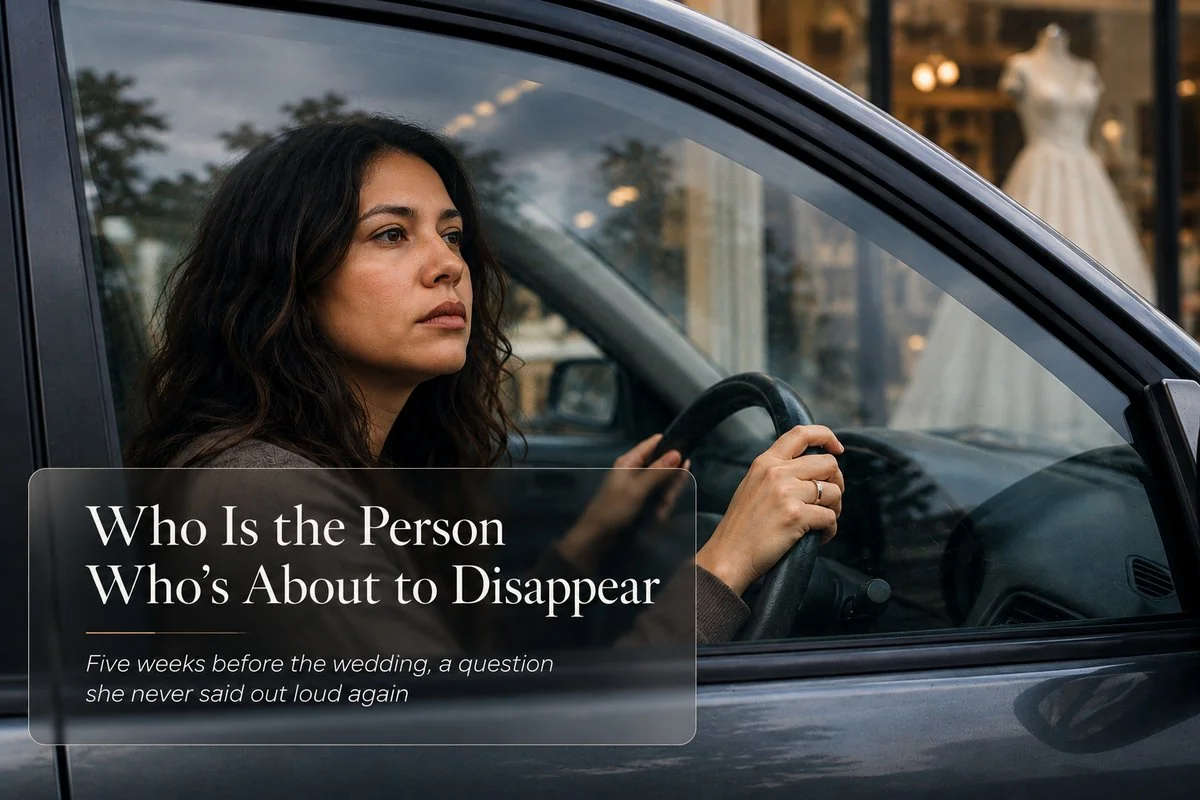
Ana never told him about that day in the car outside the bridal shop — the eleven minutes she sat there before she could make herself go in for the final fitting. There was no reason she would have. As far as Mark knew, there had never been a day like that at all.
Five weeks before the wedding, she sat with the engine off and her hands still on the wheel, and asked herself a question she never said out loud to anyone, not then and not after: who is the person who's about to disappear.
It wasn't nerves, exactly. She loved Mark. That part had never once been the question, not for a single day since she'd met him — not on the worst nights of the wedding planning, not in the arguments about the guest list, not even now, sitting in a parked car outside a shop full of white dresses. If anyone had asked her, right there, do you love him, she would have answered before they'd finished the sentence.
The question underneath was different, and much harder to say out loud, even to herself.
Because that was what marriage felt like to her that month, whether or not it was fair to feel that way. Not a loss of Mark — a loss of the version of Ana that had existed before Mark. The one who used to leave a party without telling anyone. The one who'd moved to San Francisco with two suitcases and no plan, just to see if she could. The one who used to be, before every decision came with someone else's name attached to it, entirely and only accountable to herself.
She didn't resent Mark for this. That was the part she couldn't make sense of later — there was no villain in the feeling. Mark had never once asked her to be smaller. If anything, he loved the version of her that did things without asking permission. It wasn't him closing a door. It was the wedding itself, the enormity of the word always, standing in front of her like a building she'd agreed to live inside for the rest of her life, and some old, private, unexamined part of her had panicked at the sheer size of it.
The man wasn't someone she'd planned to see. That mattered to her, after, in a way she knew wouldn't matter to Mark, or to anyone else who heard the story — the difference between planning a betrayal and simply not walking away from one when it appeared. She'd run into him at a going-away dinner for a coworker, someone from a life that had nothing to do with Mark at all, a life from three years earlier that she hadn't thought about in months. He hadn't pursued her. She hadn't resisted very hard, either. That was the truth of it, and she made herself hold onto that truth instead of softening it, because softening it was exactly the kind of thing she promised herself she'd never do.
She could tell herself, and it would even be true, that it happened during the loneliest stretch of the engagement — the months where Mark was buried in a bridge retrofit project that had him at the office until nine most nights, where she was managing seating charts and her mother's opinions and a version of her own life that had started to feel, temporarily, like an events calendar instead of a relationship, a life so overtaken by other people's logistics that even her own pill pack, most weeks, went untouched past ten at night, then forgotten outright, then not thought about at all. That explanation was real. It was also, she knew, not sufficient. Plenty of engaged people go through lonely stretches and don't do what she did. She'd turned the loneliness into a door, when she could have just as easily let it stay a wall.
What she actually wanted, that night, wasn't him. She understood this more clearly than she wanted to. What she wanted was one hour of being nobody's fiancée — one hour where nothing about her was already spoken for, where she hadn't yet signed away the version of herself who used to make reckless, unaccountable choices at eleven p.m. and answer to no one for them in the morning. She got that hour. She has never, since, been able to convince herself it was worth what it cost.
She didn't tell Mark. She built, in the following days, a version of the story where it hadn't really happened — not a lie exactly, more a private agreement with herself not to look directly at it, the way you don't look directly at the sun. She went back to seating charts. She went back to being, in every visible way, a woman who couldn't wait to marry him.
And that part wasn't a performance. That was the unbearable thing she'd have to live with later — that loving Mark and doing this were not, in her, two separate rooms. They existed in the same person, at the same time, and she has never fully forgiven herself for how easily she managed both.
By the time she stood in the dressing room five weeks later, arms raised while a stranger pinned the waist of a dress she'd chosen a year earlier, she had already decided — quietly, without ever framing it as a decision — that she would marry him anyway, and never say a word, and simply become, through sheer effort, the woman standing in the mirror. Devoted. Present. Done with disappearing.
She almost managed it. She would have gone on managing it, maybe for years, if her body hadn't made a decision of its own nine weeks after the wedding, one she had no ability to argue with, negotiate around, or keep private any longer.
That decision arrived on an ordinary morning, with her hand over her mouth in the passenger seat of Mark's car, on the way to her mother's house, in front of a man who had no reason yet to ask her anything at all.
Part Three — Load-Bearing
Mark's job, in the plainest terms, was to tell people what their buildings could survive.
Not survive in the abstract — survive a specific earthquake, a specific wind load, a specific number of years of fog rolling down off Twin Peaks and salting every joint and rivet in the city. He spent his days with tolerances and margins, numbers that existed precisely so nobody would ever have to guess whether something might fail. That was the whole point of the profession. You didn't hope a retaining wall would hold. You calculated it.
It did not occur to him, in the third month of his marriage, that he had never once run those numbers on his own life. He had simply assumed the load.
The vomiting in the car, the quiet ride home, the tearful I love you he'd taken for relief — all of it had settled, in his mind, into a single closed folder marked a hard day, now over. He had no reason yet to reopen it. That would come later, one symptom at a time, the way most things that eventually break first arrive as things that merely creak.
···
The coffee went next. Ana had made a full pot every morning since the wedding — his mother had taught her the ratio the week before, a small tender inheritance passed between two women who'd decided to like each other — and then, on a Tuesday in April, she poured it out untouched and said the smell was doing something to her stomach.
"Since when?" he asked, only half paying attention, tying his shoe against the hallway wall.
"I don't know. New shampoo, maybe. Or I'm getting sick."
He believed her the way you believe a wall is plumb because it's always looked plumb. He had no reason to check.
But small things kept not lining up, the way a door that used to close easily starts, almost imperceptibly, to stick. She stopped finishing dinner. She started declining wine before he'd even opened it, which was new, because she used to be the one to suggest it. Twice he came home to find her asleep at six in the evening, still in her coat, as if she'd sat down for a moment and simply gone under.
He noticed. He always noticed. It was the same attentiveness the job had trained into him — the eye that catches the hairline crack before it becomes the reason a ceiling comes down. He just didn't let himself finish the thought. A crack, after all, doesn't always mean collapse. Sometimes it's just settling. Old houses settle. New marriages, he told himself, probably do too.
···
He built himself an entire architecture of reasonable explanations, and he built it carefully, the way he built everything.
She's adjusting. People married three months don't yet know each other's weather, and adjustment has a way of looking, from the outside, like distance.
Her mother. Ana had been going over there more, and her mother's health had never been simple. Grief borrows people. It doesn't announce itself.
One evening, driving her mother home from an appointment, Ana took the long way back — the road that curves above the bay before it drops down toward the avenues — and pulled over where the shoulder widens, telling herself she just needed a minute before facing the rest of the night. She didn't cry, not really. She sat with both hands still on the wheel, ten and two, the way her driving instructor had taught her a decade ago, and found some strange comfort in doing at least one small thing correctly. Below her, the lights on the water didn't care one way or another. After a while she checked her mirror, signaled, and pulled back onto the road like anyone else driving home.
Me. Maybe he was the variable. Maybe he'd changed since the wedding in some way he couldn't see from inside his own skin, and she was only responding to a shift he'd caused.
He preferred, always, to be the load-bearing problem rather than let the crack be in her.
He never once asked her outright. He circled the question instead, the way an engineer walks a structure's perimeter before touching anything — You've seemed tired lately. You sure you're alright? You know you can tell me anything — and every time, she gave him an answer smooth enough to stand on, and he let his weight rest there again, because it held.
It always held. Until the day it didn't have to hold anything at all, because he found out the truth by accident, standing in his own kitchen, looking for a pen.
The night before that happened, Ana stood a long moment in the hallway after Mark had fallen asleep, one hand flat against the wall as if she were checking it for warmth. She had gotten good, these last weeks, at being two people at once — the one who loved him without complication, and the one who'd broken something before he'd ever had the chance to hold it. She wasn't sure yet which of them was going to have to answer for it. Down the hall, Mark shifted in his sleep and said something to nobody. Ana let her hand drop, and went back to bed beside him, careful not to let the mattress dip too suddenly.
···
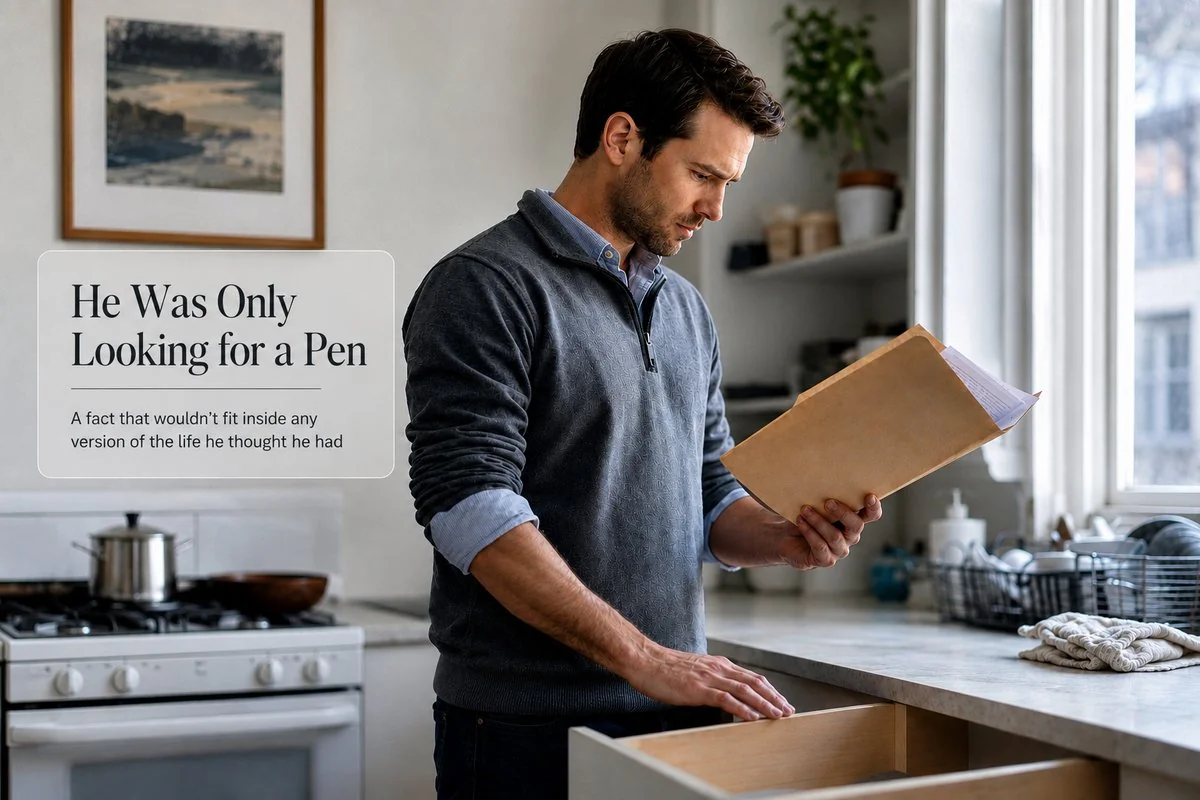
The folder was hers — insurance paperwork, she'd said, needing a signature — left on the counter between the fruit bowl and the bills. He wasn't looking for anything except a pen, and the drawer where the pens lived was, that week, inexplicably empty, so he opened the folder instead, thinking there might be one clipped inside.
There wasn't. There was a clinic intake form from a practice in the Sunset he'd never heard of, dated three weeks earlier, and beneath the letterhead, in the flat, uncurious print of a receptionist who types the same words forty times a day: Confirmed intrauterine pregnancy, approx. 9 weeks.
He read it standing up. He read it again sitting down, though he didn't remember choosing to sit.
Nine weeks put it before the wedding. He didn't need a calendar for that; he could feel the number land, the way you feel the specific gravity of a fact your body understands before your mind catches up to it. Nine weeks put it in February, and in February they had still been finishing the last vendor payments from the ceremony, still saying not yet, not for two years, let's actually enjoy this first — a promise they'd made lying in bed with the city lights coming through the blinds, a promise he had believed the way he believed anything Ana told him, which is to say completely, because he had never once needed a reason to doubt her.
There is a specific, terrible clarity that comes when a fact simply will not fit inside any version of events you're willing to live in. Mark had spent his whole career learning to trust that kind of clarity. It was, professionally speaking, the moment you stop asking is something wrong and start asking how much weight is this actually carrying, and for how long.
He put the folder back exactly as he'd found it. He did not find a pen.
···
He drove home that night the same route he always drove, past the same closed dry cleaner and the same fogged-over gas station sign, and none of it looked any different, which struck him, distantly, as its own kind of wrong. The world is supposed to look different once you know something like this. It doesn't. That was the part nobody prepared him for.
He didn't confront her. He kept turning the word over — confront — and it kept feeling like the wrong tool for the job, like using a sledgehammer where the actual problem was a hairline fracture nobody could see from the outside yet. What he wanted wasn't a fight. He wasn't even sure, yet, that he wanted the truth. He wanted, if he was honest, to go back to not knowing — to the version of the evening where he'd never needed a pen.
So he said nothing. For three days he said nothing, and the not-saying took on its own physical presence in the apartment, the way silence does when both people know it's no longer just quiet. Ana felt it before she could have named it — felt the specific weight of a husband who had stopped asking are you okay, when for weeks that question had been the one constant in every conversation. Its absence was louder than it had ever been present.
On the third night, in the dark, she was the one who finally couldn't hold it anymore.
"Mark." Barely a sound. "I need to say something, and I need you to let me get through it."
He didn't move. He'd been awake, by then, for most of three nights running, doing the thing his training had taught him never to do with an actual structure — waiting to see how much it could take before he intervened.
"Before you," she said, "there was someone. One night. It didn't mean anything, and I know how that sounds, I know that's what everyone says, but I swear to you it was over before it started and I never — I never planned for it to become anything." Her breath caught somewhere between the words. "I'm pregnant. It happened before the wedding. It isn't yours."
The room did not go silent so much as it went still, the particular stillness of a structure at the exact instant a load exceeds what it was built to carry — not a crash yet, just the held breath before one.
"I told myself I'd tell you before we married," she said. "Every single day, I told myself today. And every day I looked at you and I thought — if I say it, I lose you, and I would rather live with the lie than live without you. I know now that was never actually a choice I was allowed to make for both of us. I made it anyway."
Mark lay there in the dark saying nothing, running, out of sheer professional habit, the numbers he could not stop himself from running: how long she'd known, how many mornings she'd poured coffee she couldn't drink and called it new shampoo, how many times he'd asked are you okay and taken the answer as load-bearing when it had never been anything but drywall.
When he finally spoke, his voice wasn't raised. It didn't need to be.
"You know what my whole job is," he said. "I tell people exactly how much a thing can carry before it fails. I have never once, in ten years, been wrong about a wall." He stopped. "I was wrong about us. I looked right at the cracks and I told myself they were just the building settling."
Ana said nothing, because there was nothing left that would hold any weight at all.
"I don't know yet what I'm going to do," he said finally. "But I'm not going back to not knowing. That part's already gone. You don't get to unpour a foundation once it's set."
Outside, the fog was doing what it always did that time of year — sliding down off the hill in the dark, indifferent, covering the whole street in the same gray, so that from outside, nothing about the house looked any different at all.
Part Four — Presumption
Eleven days after the night she told him, Mark drove to a law office in the Financial District instead of to work, and told his firm he had a dentist appointment.
He hadn't told Ana where he was going. He'd told her almost nothing, in eleven days — not out of cruelty, though he suspected it felt that way to her some mornings, but because he genuinely didn't have anything finished enough yet to hand her. He was still, in the only language he fully trusted, running the numbers.
The lawyer's office had the particular calm of rooms where other people's disasters were routine. Mark sat across from a woman named Patricia Ostrander, who had the unhurried patience of someone who had explained this exact situation more times than he wanted to know existed.
"I want to understand something plainly," he said. "If I do nothing. If I just — let this happen the way it's happening. What happens on the day the baby's born?"
"On the day the baby's born," Patricia said, "you're the legal father. Automatically. It's called the marital presumption — a child born to a married woman in California is presumed, by law, to be her husband's. Doesn't matter what a DNA test would say. Doesn't matter what either of you knows privately. Your name goes on the birth certificate unless you take specific legal steps to prevent it."
"And if I want to prevent it?"
"Then you'd need to file to disestablish paternity. There's a process. It's not instant, and it's not free, and I won't pretend it's painless for anyone involved, including the child eventually, if they ever find the paperwork. But it exists, and the window to use it doesn't stay open forever."
Mark sat with that.
It was, he realized, the first time in eleven days that the situation had produced an actual number. Not a feeling. Not a version of the story he could revise overnight depending on how angry or how tired he was. A date. A form. A window that would close whether or not he'd made up his mind by the time it did.
He almost laughed, and didn't, because it wasn't funny, but it was familiar in a way that steadied him anyway — the same relief he felt walking a job site after weeks of theoretical drawings. Something to actually measure.
"So," he said, "the law doesn't wait for me to feel ready."
"No," Patricia said. "The law's never once asked anybody if they felt ready."
She was quiet a moment, watching him the way people in her profession learn to watch — for the difference between a client who wants options and a client who wants permission.
"I can draft the petition now," she said. "That doesn't commit you to anything. It just means the moment you decide, you decide — you're not also waiting on paperwork on top of everything else you're carrying. Some of my clients want that. Having it ready, whether or not they ever use it."
Mark thought about it longer than the question probably warranted.
"Draft it," he said.
She had it ready before he left the building — three pages, stapled, his name typed at the top of a form he hadn't asked to need. He folded it once, then again, smaller than it wanted to fold, and put it in the inside pocket of his jacket, where it stayed, untouched, for longer than either of them would have guessed that day.
···
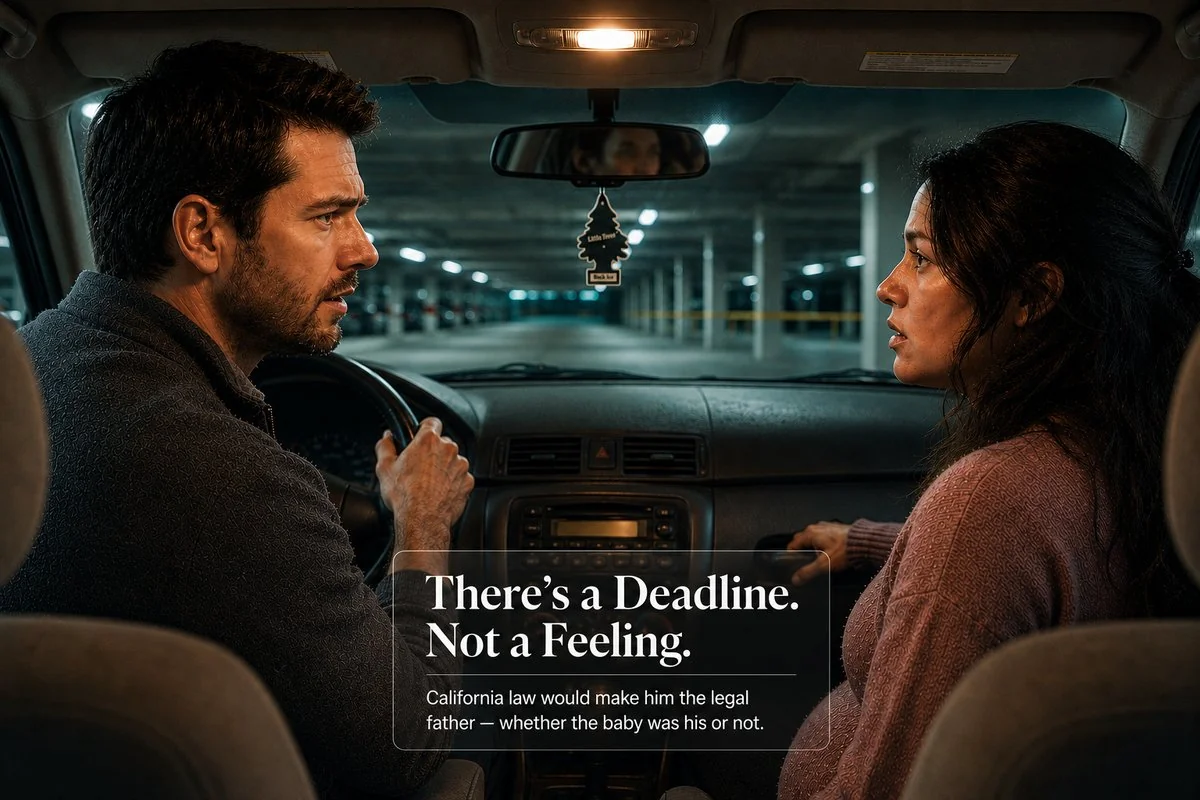
He didn't file anything that day. He didn't tell Ana about Patricia Ostrander for another four days, and when he finally did, it wasn't at home — it was in the car, in the parking lot of her OB's office, engine off, waiting for her to come out from an appointment he hadn't been invited to and hadn't asked to attend.
She got in, closed the door, and saw his face before he said a word.
"You went to a lawyer."
"I did."
She didn't ask which kind. She already knew.
"Am I allowed to ask what he said?"
"She. And yes." He kept his hands on the wheel, not driving anywhere yet. "There's a deadline, Ana. Not a feeling. An actual deadline. If I don't do anything, I'm the father. Legally, permanently, the day this baby's born, whether or not it's true. If I want out, there's a window, and it closes."
Ana looked straight ahead, out through the windshield at a parking structure that had nothing to say to either of them.
"So now there's a form for this," she said quietly. "Of course there is."
"I'm not telling you this to scare you."
"Then why are you telling me."
"Because I've spent eleven days waiting to feel certain enough to talk to you, and I'm not going to. I don't think I get to be certain. I think certainty was never going to be on the table again, for either of us, maybe for a long time. But a form doesn't care whether I'm certain. It just closes."
She turned to look at him then, and for the first time since the confession, he watched her actually brace for whatever he was about to say next, instead of already knowing it.
"I'm not deciding today," he said. "I want to be straight with you about that, because I think you'd rather know than hope. I'm not divorcing you today and I'm not staying today and I'm not signing anything today. What I want — what I think we actually need, because I don't trust either one of us to make a permanent decision inside a feeling this big — is time. Real time. Not eleven days. Something with an actual shape to it."
"What kind of shape."
"Six months," he said. "Not as a countdown to divorce. Not as a countdown to forgiveness either. Just — six months where neither of us is allowed to say the big, permanent thing out loud, where we're not re-litigating the same fight every single night, where we actually see somebody whose whole job is to help people not blow up their lives in the middle of the worst week of them. And at the end of it, we look at where we actually are. Not where we hoped we'd be. Where we are."
Ana's hand had found the door handle without her seeming to notice, not to leave, just to hold onto something.
"And the form," she said. "The legal one. What happens to that, inside your six months?"
"I checked. There's enough time. Not a lot. Enough." He finally looked at her instead of the windshield. "I'm not promising you an answer, Ana. I want to be honest about that, because I think you'd rather have honesty than comfort right now, even though I know comfort is what you actually want. I'm promising you a process. That's different. It might end with me raising this baby. It might end with me filing that form the week the window closes. I genuinely don't know yet, and anyone who tells you they'd know by day eleven is lying to you or to themselves."
Ana was quiet long enough that the parking structure's automatic lights buzzed and dimmed once, sensing no motion.
"Okay," she finally said. Just that.
"Okay?"
"You're an engineer," she said, and something almost like the old, easy fondness moved across her face before it was gone again. "Of course you turned our marriage into a load calculation with a filing deadline."
"It's the only language I've got that doesn't fall apart on me."
"I know." She looked down at her own hands. "I think I'm going to need you to teach me some of it. Because whatever I've been using instead hasn't held up either."
Neither of them started the car for a while. Outside, the fog was already sliding in early, the way it did some afternoons for no reason anyone could ever quite predict, softening the hard edges of the parking structure until it looked, for a few minutes, almost like something that could be leaned on.
Part Five — Reinforcement
Nine days after the conversation in the parking structure, Mark was on a job site in the Mission, signing off on retrofit drawings for a building that had survived the '89 quake by six inches of clearance nobody had planned for, when Gary from the permitting office clapped him on the shoulder and said, "Heard congratulations are in order."
Mark didn't understand at first. Then he did.
"Ana's mom mentioned it to my wife at the farmers market," Gary said, grinning, oblivious. "First one, right? Man, wait'll you feel that first kick. Changes everything."
Mark said something. He didn't remember what. He signed the drawings wrong — flagged a load path that didn't need flagging — and had to redo the whole sheet that night at the kitchen table, alone, because Ana was at a prenatal appointment he hadn't offered to go to and she hadn't asked him to.
He didn't tell her about Gary. He told himself it wasn't worth the fight. What he actually meant was that he didn't trust what would come out of his mouth if he started.
···
It came out anyway, four nights later, over something that had nothing to do with any of it.
She'd left a wet towel on the bathroom floor. That was the whole thing. A towel.
"You could just pick it up," she said, not even looking up from her phone.
"I have picked it up. Every day. For three years I've picked up your towels and never said one word about it, and I don't even care about the towel, Ana, I don't care about the towel—"
"Then what do you care about."
"I care that Gary from permitting knew before I did that your mother's telling people at the farmers market that we're having a baby. Our baby. That's the phrase she used, I'm sure. Our baby." His voice had gone somewhere he didn't recognize, too loud for the kitchen, too loud for a Tuesday. "You're letting people congratulate me."
"What was I supposed to tell my mother, Mark? The truth? Should I have said, congratulations, but actually—"
"I don't know! I don't know what you're supposed to say to your mother, that was never going to be my problem to solve, except now it is, now everything is, now I'm standing on a job site getting hit on the shoulder for something that isn't—"
He stopped.
Ana had gone very still, the phone forgotten in her hand.
"Finish it," she said quietly.
He didn't.
"Say it, Mark. Something that isn't yours. Just say it. You've been not-saying it for two weeks and I would rather you say it to my face than watch you almost-say it every single day."
"I don't know what I feel," he said, which was true, and which was also, he understood the second it left him, a smaller and safer thing than what he'd actually been about to say.
Ana picked the towel up off the floor herself and left the room without another word, and Mark stood in the kitchen a long time afterward, furious at Gary, furious at her mother, furious at the fact that his hands were shaking, and unable to locate a single person in the whole chain of it who actually deserved the fury he was carrying.
···
Two nights after the towel, he told her about the form himself. He hadn't planned to — he'd told himself he'd keep it to himself until he actually knew something worth telling her — but the fight found its way there anyway, the way arguments in a marriage under strain always seem to find the one door neither person meant to open.
"You want to know what I've actually been carrying around," he said, and before he could talk himself out of it, he took the folded pages from his jacket on the back of the chair and set them on the table between them, smoothing them flat with two fingers.
Ana looked down at them a long moment before she picked them up.
"You had this drafted," she said. Not a question.
"Eleven days ago."
"Eleven days you've had this in your pocket, and you sat with me at the — you let me think—" She stopped herself, started again, quieter and worse for being quieter. "Is this why you're still here. Is this the actual reason. So you could tell yourself you tried, before you—"
"I don't know," Mark said, and it cost him something to say it, she could see that, but it didn't make it easier to hear. "I told you I don't know yet. I needed it to exist so that whenever I did decide, it would actually be mine — not just whatever the calendar forced on me at the last minute. That's the only reason it's in my pocket. I've read it maybe four times. I haven't signed one line of it."
"That's very tidy," Ana said. "For you."
She set the pages back down, not gently, and went to bed without another word. Mark folded them the same two folds as always and put the jacket back on the chair, because he didn't know, that night, what else a person was supposed to do with a piece of paper that hadn't finished deciding what it was yet — and because some part of him understood, even then, that showing it to her instead of hiding it had been its own kind of answer, even if neither of them could read it correctly yet.
···
The night he almost left was ordinary in every way that mattered, which was, he thought later, the truest thing about it. No fight preceded it. Ana was asleep. He packed nothing dramatic — just a duffel with two days of clothes, the way he'd pack for a job site out of town — and he sat in the driver's seat in the driveway with the keys in his hand for eleven minutes, the exact same eleven minutes, he'd realize much later, that Ana herself had once spent outside a bridal shop, though neither of them would ever know they'd matched each other's stillness so precisely.
He didn't drive anywhere. He sat, and he ran the only numbers he knew how to run.
If I leave tonight, what does that solve. Nothing. It solved nothing. It just relocated the problem to a hotel room and gave it a worse view.
If I stay because I'm afraid of losing her, is that the same as staying because it's right. He genuinely didn't know. He suspected it wasn't the same at all, and he suspected, worse, that he might not ever be able to fully separate the two reasons from each other, not now, maybe not ever — that some blend of love and fear was probably what kept most marriages standing on any given Tuesday, his parents' included, and he'd never once thought to ask them which part was which.
He went back inside. He put the duffel back in the closet. He didn't tell her, the next morning or ever, how close eleven minutes had actually come to becoming something else.
···
The nineteen-week appointment was the one he almost skipped.
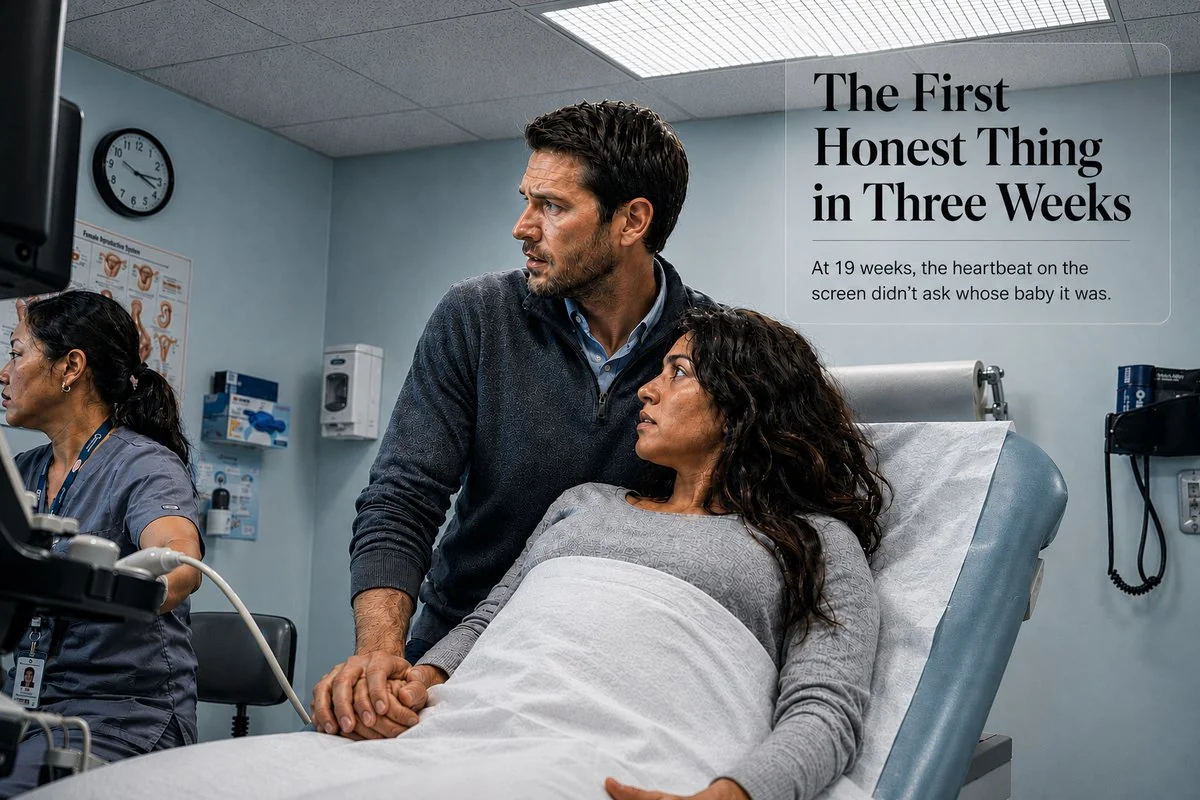
He went anyway — not out of resolve, more out of the specific cowardice of not wanting to be the one who explained his absence to her mother. The ultrasound room in the Sunset smelled like hand sanitizer and the particular recycled warmth of a space with no windows. The tech, a woman named Dolores with a Warriors lanyard and a voice pitched for exactly this kind of room, made small talk about the fog while she squeezed gel onto Ana's stomach that Mark noted, absurdly, was the same temperature as everything else in the room, which was to say, deliberately, clinically, nothing.
"Dad, you want to come around this side, you'll see better."
Mark didn't correct her.
He came around the side.
On the screen, in grainy black and white, was a shape that resolved, after a moment of Dolores's practiced narration, into a spine, a curled set of ribs, a hand that opened and closed once, for no reason a fetus that size could possibly have had, except that hands do that, apparently, long before there's anything for them to hold.
"Strong heartbeat," Dolores said, matter-of-fact, the way she'd probably said it four thousand times before to four thousand different rooms full of people with four thousand different private wreckages nobody in scrubs was ever going to ask about. "Want to hear it?"
Ana's hand found his without either of them deciding it should. He let her take it.
The sound, when it came, wasn't the swelling movie-score thing he'd half expected and privately dreaded. It was fast and a little tinny and almost mechanical, closer to a fan belt than anything he'd have called a heart, and it was, for reasons he couldn't have defended to anyone, the first honest thing that had happened to him in three weeks.
He didn't cry. He didn't say anything meaningful. He stood there holding his wife's hand in a windowless room in the Sunset, listening to a sound that belonged to a person who didn't yet know a single thing about the mess it had been born into, and he thought, with the same flat clarity he brought to a load calculation: that's not going anywhere. Whatever I decide, that heartbeat isn't the variable. I am.
···
He told her three nights later, at the kitchen table, no towel on the floor this time, nothing dramatic set up around it.
"I'm not going to pretend I've made peace with all of it," he said. "There's a version of me that's still furious, and I don't think that version fully goes away. I haven't forgiven you. I want to say that to your face instead of letting you guess at it."
Ana didn't interrupt. She'd learned, these past weeks, when not to.
"But I've run every version of leaving, every single one, and none of them get me anything except being alone with the same broken heart, just in worse company. I think I already knew what I was going to do the night I sat in the driveway and didn't drive anywhere. I just needed the rest of me to catch up to it."
"You never told me about that."
"I'm telling you now."
He reached back for the jacket on the chair behind him, and took the folded pages out of the inside pocket — the same three pages, the same two folds, carried for longer now than either of them had kept count of.
Ana went very still.
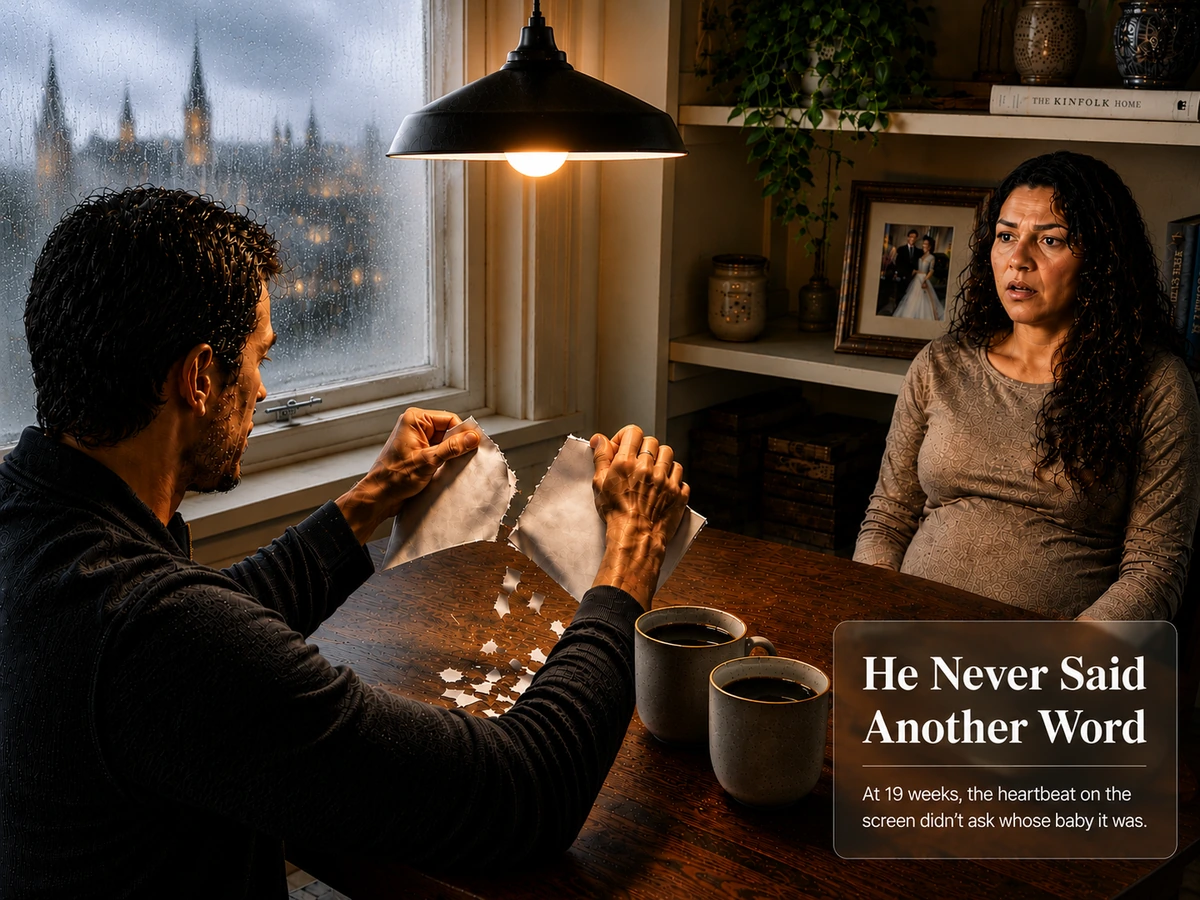
He didn't say anything else. He held the pages a moment, looking at them the way he looked at a set of drawings before he signed off on them, and then he tore them once, and once more, and let the pieces fall onto the table between them.
···
Frequently Asked Questions
Is "The Baby That Wasn't His" a true story?
No — this is a fictional story. It was written for emotional and narrative honesty rather than as an account of real events, though several of the ideas underneath it (see below) are drawn from real family law and real research on infidelity recovery.
If a pregnancy happened before marriage with someone other than the husband, is the husband legally the father once the couple marries?
In California, this can be true. Family Code §7540 sets out a marital presumption of parentage: a child born to a woman who is married and cohabiting with her husband is presumed to be a child of that marriage, regardless of biology, unless the husband was impotent or sterile. This presumption exists to protect family stability, not to determine biological fact — and it applies even if the pregnancy began before the wedding.
Can a husband challenge that presumption, the way Mark considers doing in the story?
Yes. Under Family Code §7541, a husband (or another party with standing) can move for genetic testing to challenge the marital presumption, but that motion must be filed within two years of the child's birth. That clock starts running at birth, not sometime during the pregnancy — stories often compress timelines like this for pacing. After the two-year window closes, the presumption becomes very difficult to challenge, regardless of DNA evidence.
Do courts ever refuse to disestablish paternity even with DNA proof?
Yes. Even within the filing window, judges retain discretion, and existing case law shows courts can decline to disestablish paternity if doing so would harm a child who has already bonded with a father figure. The law generally treats a child's stability as more important than strict biological accuracy once that bond exists.
Is it realistic for a marriage to recover from this kind of betrayal in about a month, the way Mark and Ana's does?
Less common than the story's pace suggests, and this is worth saying plainly. Therapists who work with infidelity — Esther Perel's writing is a well-known reference point — generally describe genuine recovery as a slower, non-linear process, often measured in many months or longer, with real setbacks along the way rather than a clean one-month arc. The story compresses this timeline for narrative pacing; it isn't meant as a realistic estimate of how long recovery actually takes.
What is "discernment counseling," which shaped Mark's original six-month framing in the story?
It's a real, established therapeutic model for couples who are ambivalent about staying together. Rather than pushing toward an immediate "stay or leave" decision, it structures a defined period — traditionally around six months — for one partner to make real, visible changes while the bigger decision is deliberately deferred. It's typically paired with concrete crisis-phase guidance: pausing permanent decisions, not re-litigating the same fight nightly, and limiting outside interference during that period.
Does the story address what happens with the biological father?
No — that thread is deliberately left open. It's a real, documented complication in situations like this, but it falls outside the scope of what this particular story set out to resolve.
📝 Editor’s note — A note on the legal and therapeutic details in this story
This story references real legal and clinical concepts — California's marital presumption of parentage (Family Code §7540–7541), the disestablishment-of-paternity process, and the discernment counseling model — to ground its fiction in something researched rather than invented. That said, this is a work of fiction, not legal or medical guidance, and some details (most notably, the pace and framing of the filing deadline in the story) are shaped for narrative tension rather than legal precision.
If you're facing a real question about parentage, custody, or a paternity filing deadline, California family law is fact-specific and outcomes turn on details a story can't capture — please talk to a licensed family law attorney rather than relying on anything above. Likewise, if you or someone you know is navigating an unplanned pregnancy, infidelity, or a marriage in crisis, a licensed marriage and family therapist can offer guidance suited to your actual situation in a way fiction isn't built to provide.
···
A
About the author
Attaullah writes about pregnancy, new parenthood, and the parts of family life that don't fit neatly into a due-date calendar — including the harder chapters, like rebuilding trust after betrayal or the legal grey areas that pregnancy and parenthood can quietly create. His work pairs real research — family law, perinatal psychology, and therapeutic frameworks like discernment counseling — with the lived, unresolved texture of real relationships, so readers walk away with both grounding and honesty, not just reassurance.
If This Stayed With You
Relationships
The Work That Disappears When It's Done Right
Jun 29, 202615 min read
For the quieter, harder-to-name work of actually rebuilding — the kind that only shows when it's missing.
Read More →
Pregnancy
How Couples Prepare for Their First Baby
Apr 20, 202614 min read
If you're standing where Mark and Ana are — about to become parents while everything else is still being renegotiated.
Read More →