You never made it to my arms. But you live in my dreams every day. This guide is for every mother who has carried that silent love — and for every woman who wants to understand what happened, why, and what comes next.
What Is a First Trimester Miscarriage?
The first trimester runs from week 1 through week 12. A miscarriage — medically called a spontaneous abortion — is any pregnancy loss before 20 weeks. When it happens in those first three months, it is called an early or first trimester miscarriage.
Here is something that surprises most people: miscarriage is not rare. Some losses happen before a woman even realises she is pregnant, which means the real numbers are often higher than what people hear about in daily life.
26%
of all pregnancies — including those that end before a woman realises she is pregnant — result in miscarriage. Among clinically confirmed pregnancies the figure sits at 10 to 20 percent. The NHS reports that 75% of all pregnancy losses occur in the first trimester.
Warning Signs — How Do You Know If It Is Happening?
An urgent ultrasound is the only way to confirm or rule out a miscarriage. Do not wait and see — call your midwife or doctor the moment you are concerned.
Many women experience light bleeding or cramping in early pregnancy and fear the worst — when in reality, about one in three pregnant women will bleed in the first trimester and still deliver a healthy baby. Spotting alone is not always a miscarriage.
But these specific signs should send you to your doctor immediately — not tomorrow, not after the weekend:
- Vaginal bleeding that progresses from light spotting to a heavier flow
- Cramping or pelvic pain that feels stronger than a normal period
- Persistent severe lower back pain that does not ease
- Passing greyish or pinkish tissue through the vagina
- A sudden and complete disappearance of all pregnancy symptoms
⚠️ Seek Urgent Care Immediately If You Have
Vaginal bleeding heavier than a period — severe abdominal pain — fever above 38°C (100.4°F) — dizziness or fainting — or a sudden complete disappearance of pregnancy symptoms with pain. Go to your doctor, midwife, or emergency room. Do not wait.
Why Does It Happen? The Real Causes of First Trimester Miscarriage
Understanding why first trimester miscarriage happens is the first step toward stopping the cycle of guilt. The causes are largely biological — most of them entirely beyond anyone's control. If you are already asking yourself whether you caused your loss, our dedicated guide on miscarriage guilt and self-blame addresses every question that keeps women awake at night.
Cause 1 — Most Common
Chromosomal Abnormalities
This accounts for 50 to 67 percent of all first trimester miscarriages. When an egg and sperm combine, they each contribute 23 chromosomes. If either carries a defect — an extra chromosome, a missing one, or a structural error — the embryo cannot survive. The body recognises this and ends the pregnancy.
This is not a failure of the mother's body. It is nature's quality control. A 2023 study in Fertility and Sterility found that when advanced genomic methods were applied, chromosomal abnormalities rose to 67.8 percent of first trimester losses.
67%
of first trimester miscarriages are caused by chromosomal abnormalities in the embryo — a biological event at the moment of cell division that is completely outside anyone's control. It was not your fault.
Cause 2
Hormonal Problems
Progesterone is called the pregnancy hormone because it maintains the uterine lining in early pregnancy. A deficiency — called luteal phase defect — can cause the lining to break down before the embryo has properly implanted. Low progesterone is one of the most common and most manageable hormonal causes of early pregnancy loss.
Cause 3
Underlying Medical Conditions
Several chronic conditions significantly raise miscarriage risk when uncontrolled: unmanaged diabetes, thyroid disorders (both underactive and overactive), autoimmune conditions — particularly antiphospholipid syndrome and lupus — and polycystic ovarian syndrome (PCOS).
Most of these are manageable. A woman with well-controlled thyroid disease or well-managed diabetes has significantly better pregnancy outcomes than one who does not know she has the condition at all. This is why preconception blood work is essential.
Cause 4
Infections
Infections account for approximately 15 percent of early miscarriages. Common culprits include Mycoplasma and Ureaplasma bacteria that colonise the reproductive tract silently, Listeria from contaminated food, Toxoplasmosis from undercooked meat and cat faeces, and the TORCH panel infections including Rubella, Cytomegalovirus, and Herpes simplex.
Cause 5
Structural Problems
A uterine septum, fibroids in certain positions, or an incompetent cervix — where the cervix weakens and opens too early — can all contribute to pregnancy loss. Structural issues are not always identified until after a loss, which is why a thorough investigation after recurrent miscarriage is so important.
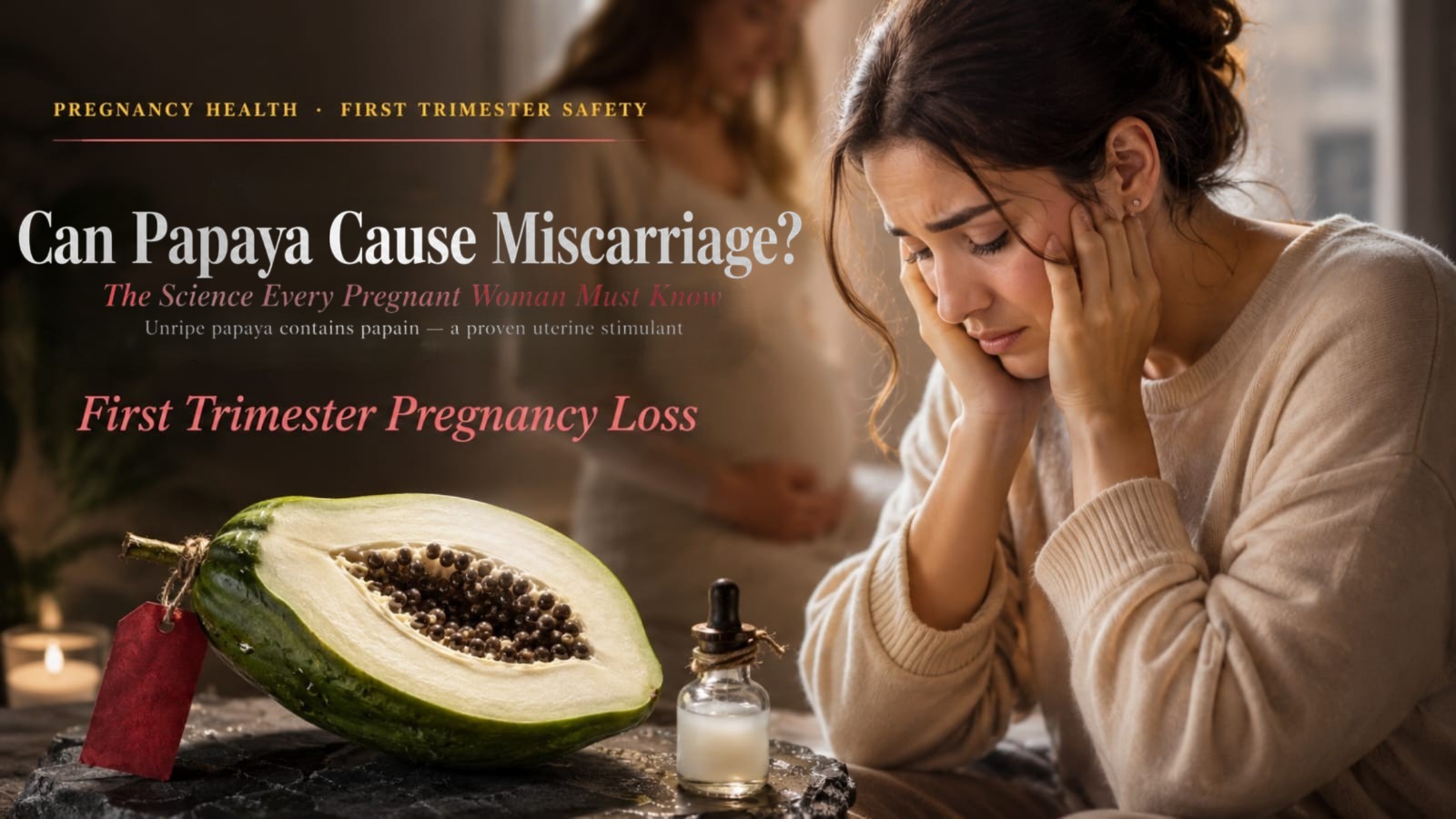
Can Papaya Cause a Miscarriage? The Science Explained
The warning about papaya in pregnancy is not a myth. Unripe papaya contains papain — an enzyme that stimulates uterine contractions. The science is clear.
This question comes up constantly — and for good reason. Grandmothers warn about it. Doctors sometimes mention it. And it turns out the concern is medically legitimate.
The short answer: yes — unripe (raw or green) papaya carries a genuine risk during early pregnancy.
Unripe papaya contains high concentrations of an enzyme called papain — a proteolytic enzyme that behaves similarly to prostaglandins, the hormone-like compounds the body uses to trigger uterine contractions during labour. When consumed in significant amounts during early pregnancy, unripe papaya can:
- Stimulate uterine contractions — the same mechanism used in medically induced labour
- Interfere with progesterone synthesis — the hormone that holds the pregnancy in place
- Cause irritation of the uterine lining, potentially leading to implantation failure
💡 Practical Answer on Papaya
Ripe orange papaya eaten occasionally is generally considered safe. The risk concentrates in raw or green unripe papaya especially in large amounts — papaya seeds which are even more concentrated in papain — and papaya latex from the cut surface of unripe fruit. When in doubt, skip it entirely during the first trimester.
Who Is at Highest Risk?
Risk is not destiny — but knowing where you stand helps you and your doctor make smarter, more proactive decisions before and during pregnancy.
- Age over 35: Women aged 35 to 39 face approximately a 20 to 35 percent miscarriage risk per pregnancy. By age 42 that figure exceeds 50 percent.
- Previous miscarriage: One prior loss does not significantly increase your baseline risk. Two consecutive losses raise it to around 30 percent. Three or more warrants full investigation.
- Smoking: Smokers face double the miscarriage risk of non-smokers. Stop completely — not when you find out you are pregnant, before.
- Obesity (BMI 30 or above): Associated with 1.5 to 2 times higher risk due to inflammatory and hormonal disruption.
- Uncontrolled chronic illness: Diabetes, thyroid disease, and autoimmune conditions that are poorly managed dramatically elevate risk.
- Alcohol and substance use: Both lower fertility and raise miscarriage risk significantly even at low levels in the first trimester.
What Can You Actually Do to Protect Your Pregnancy?
Here is the honest answer: you cannot prevent a chromosomal miscarriage. Nobody can. But you can absolutely reduce the modifiable risk factors — the ones that are within your control.
- Get a full preconception workup — thyroid panel, blood sugar, autoimmune markers and infection screen before you try to conceive
- Start folic acid 400 to 800 mcg daily at least one month before conception and continue through the first trimester
- Stop smoking immediately — both partners, before trying to conceive
- Limit caffeine to under 200 mg per day — roughly one cup of coffee
- Avoid NSAIDs like ibuprofen during early pregnancy — studies link them to increased miscarriage risk
- Avoid unripe papaya, raw papaya seeds and high-latex tropical fruits entirely in the first trimester
- Attend every early pregnancy scan — a confirmed heartbeat at 7 weeks drops your remaining miscarriage risk to under 5 percent
💡 The Single Most Impactful Step
Book a preconception appointment with your GP (UK), family doctor (Canada), or OB-GYN (USA) before you begin trying to conceive. A single appointment can identify thyroid disorders, anaemia, infections, autoimmune conditions and diabetes — most of which are entirely manageable when caught early.
Myths vs Truth — The Most Persistent Miscarriage Myths
Misinformation about miscarriage causes real lasting harm to women who are already grieving. These myths need to be cleared firmly and permanently.
❌ Myth
"You did something wrong. You caused it."
✅ Truth
In the overwhelming majority of first trimester losses the cause is chromosomal — a biological event no behaviour could have changed. Exercise did not cause it. Sex did not cause it. Stress did not cause it. The guilt you are carrying was never yours to carry. Read the full honest answer in our article Did I Cause My Miscarriage? — or read how Olivia carried this same guilt after her first pregnancy loss.
❌ Myth
"Exercise and sex cause miscarriage."
✅ Truth
ACOG and NHS both confirm that moderate exercise and sexual activity do not increase miscarriage risk in women with normal pregnancies. Unless your doctor has specifically advised otherwise, these activities are safe.
❌ Myth
"Once you have one miscarriage, you will keep having them."
✅ Truth
A single miscarriage does not meaningfully raise your risk for the next pregnancy. Even women who have experienced three consecutive losses have approximately a 70 percent chance of a successful next pregnancy.
❌ Myth
"Miscarriage is rare."
✅ Truth
It affects roughly 1 in 4 known pregnancies. It is common. It is just not talked about — which is exactly why so many women suffer alone believing they are the exception. You are not the exception. You are not alone.
Frequently Asked Questions
Why do most miscarriages happen in the first trimester?
The first trimester is when the embryo is most genetically vulnerable. Around 50 to 67 percent of first trimester miscarriages are caused by chromosomal abnormalities — a random biological event at the moment of fertilisation that is entirely outside anyone's control.
Is spotting always a sign of miscarriage?
No. Light spotting can occur in early pregnancy from implantation bleeding or cervical sensitivity and does not automatically mean miscarriage. However spotting combined with cramping, tissue passing, or a sudden loss of all pregnancy symptoms always warrants immediate medical assessment.
Can papaya cause a miscarriage?
Unripe or raw papaya poses a genuine risk because it contains papain — an enzyme that stimulates uterine contractions and interferes with progesterone. Ripe papaya in moderate amounts is generally considered safe. Avoid unripe papaya, seeds and papaya latex entirely during the first trimester.
Does one miscarriage increase the chance of another?
One miscarriage does not significantly raise your risk for the next pregnancy. Around 75 percent of women who experience a single loss go on to have a successful subsequent pregnancy. Only after three or more consecutive losses is a full recurrent miscarriage investigation recommended.
When should I go to a doctor for bleeding in pregnancy?
Immediately if bleeding is heavier than spotting, accompanied by cramping or pain, or if you are passing tissue. Same-day contact with your midwife or GP if you experience any spotting in the first trimester — not to panic, but because you deserve to be assessed and reassured promptly.
A Final Word
"The body's instinct is not failure. Most of the time, it is protection. Keep going. Get the bloodwork. Ask the hard questions. And never, ever carry the guilt of something that was never in your hands."
— Nestly Parenting
Medicine has come far enough that with early screening, the right tests, and a doctor who takes your history seriously, the vast majority of women who have faced pregnancy loss go on to hold a healthy baby. That number — 75 percent — is not a statistic. It is real people. Real babies. Real families.
Keep going. Get the bloodwork. Ask the hard questions. And never carry the guilt of something that was never in your hands.
First Trimester Miscarriage
Pregnancy Loss
Miscarriage Causes
Papaya Pregnancy
Chromosomal Abnormality
Pregnancy Health
USA · Canada · UK
📚 Medical References & Sources
- American College of Obstetricians and Gynecologists (ACOG). Early Pregnancy Loss. Practice Bulletin No. 200. Obstetrics & Gynecology. 2018.
- Wilcox AJ, et al. Incidence of early loss of pregnancy. New England Journal of Medicine. 1988;319:189–194.
- NHS UK. Miscarriage — Overview. National Health Service. Reviewed 2023.
- Fertility and Sterility. Genetic Causes of Sporadic and Recurrent Miscarriage. 2023.
- Lohiya NK, et al. Contraceptive evaluation and toxicological study of Carica papaya seed extract. British Journal of Nutrition.
- Nybo Andersen AM, et al. Maternal age and fetal loss. BMJ. 2000;320:1708–1712.
- Pineles BL, et al. Miscarriage and maternal exposure to tobacco smoke. American Journal of Epidemiology. 2014.
- World Health Organization. WHO Recommendations on Antenatal Care. 2016.
- Tommy's Charity UK — Missed Miscarriage Research (tommys.org)
- Royal College of Obstetricians and Gynaecologists — Recurrent Miscarriage Guidelines (rcog.org.uk)
A
Attaullah
Founder of Nestly Parenting. A researcher, writer, and passionate advocate for honest, practical parenting education. Writing to make new parenthood feel less lonely — one article at a time. Learn more →





💬 Leave a Comment
Sign in with GitHub to comment. This is a safe and supportive space.